Terms and Concepts
The following are the major terms and concepts used by QMetry Test Management for Jira.
Term | Description |
|---|---|
Bug | A defect or issue identified as an error or unintended behavior in the application that causes it to function incorrectly or produce incorrect results. |
Build | A Build is a specific iteration of the product or project being tested. Other common names for a Build are "Drop" or "Iteration". |
Environment | Test Environments are platforms, configurations, and hardware and software setups used to execute test cases. |
Exploratory Testing | Exploratory Testing is a Chrome Extension designed to empower users to test websites as they explore. |
QMetry Intelligence | AI-powered features that enable you to accelerate the test management process through the utilization of Artificial Intelligence (AI) and Machine Learning. |
Spaces | Jira's terminology update from ‘Projects’ to ‘Spaces’. |
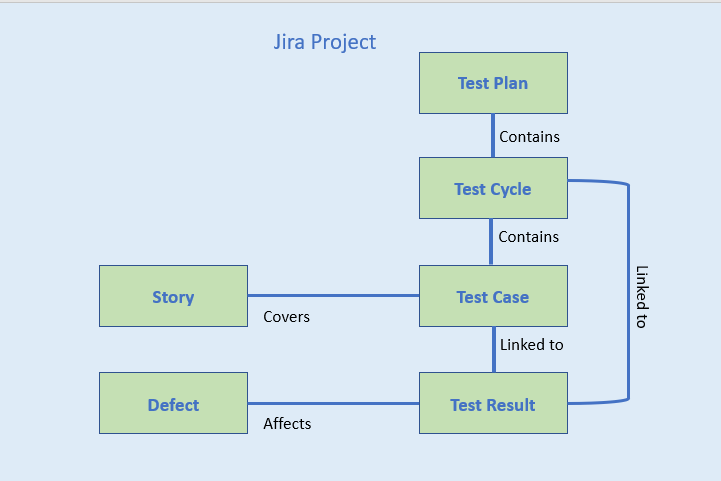
Test Case | A test case is a sequence of steps to validate the acceptable functioning of a module, requirement, or user scenario. |
Test Cycle | A test cycle is an exercise in which an ordered list of test cases assigned to individual testers is executed for a specific build of the product or artifact being tested. Usually, test cycles are bound to a platform or environment, although they can span multiple environments. |
Test Plan | A test plan is a high-level strategy that drives end-to-end comprehensive testing before a release can be deployed in production. |
Test Result | A test result is the outcome of the testing process, including the test case status (Pass, Fail, and so on). |
Work/Work Item | Jira's terminology update from ‘Issue’ to ‘Work Item’. |
The following diagram shows a high-level overview of the relationship between QMetry Test Management and Jira.